 Dynamick MindView the work
Books & practical tools
Understand the process. Practice the response.
Look beneath the words exchanged during conflict. These resources show how a reaction develops within one person, how it moves between two people, and what you can do before the process produces the next consequence.
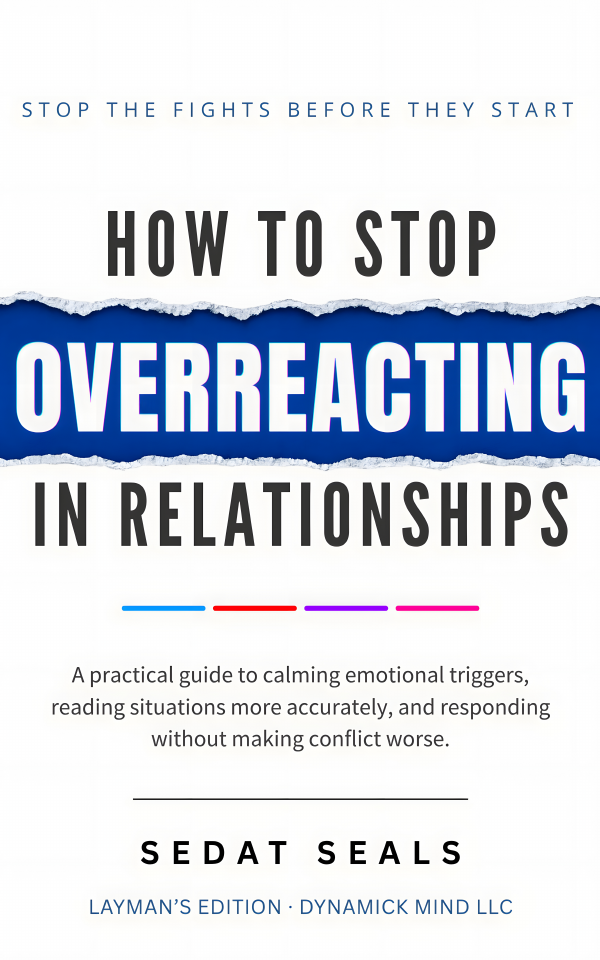
Layman’s Edition · Sedat Seals
Relationships & regulation
How to Stop Overreacting in Relationships
Conflict often begins before the first damaging sentence. Your body changes state. Attention narrows. Memory and prediction enter the present. An interpretation starts to feel like fact. This book makes that sequence visible and shows you how to regulate activation, read the situation more accurately, and respond without driving the conflict further.
These reactions do not define who you are. They are processes with conditions, sequences, and consequences. When the sequence becomes visible, you gain more opportunities to interrupt it before it determines what you do next.
Inside the book
From automatic reaction to cultivated response.
The first four chapters examine what happens within one person. The next four examine the two-person loop and the practices that can change it.
- 01What Overreaction Actually Is
Separate an automatic reaction from a cultivated response.
- 02What Happens in Your Body
Recognize activation, baseline stress, and early physical signals.
- 03How Interpretation Expands Conflict
Distinguish an event from the meaning added to it.
- 04How Memory and Conditioning Shape Today’s Reactions
See how stored patterns influence the present.
- 05When Two Nervous Systems Trigger Each Other
Understand the feedback loop between two people.
- 06What Words Do When You’re Triggered
Notice how tone, criticism, defense, and withdrawal affect the loop.
- 07What You Do When Nothing Is Wrong
Lower baseline reactivity before conflict begins.
- 08What You Do in the Moment
Pause, name your state, postpone decisions, and repair.
One example
A late reply is not yet a relationship conclusion.
Awareness does not prove that the interpretation is wrong. It helps you recognize each transition before you react from the final conclusion.
Four direct tools
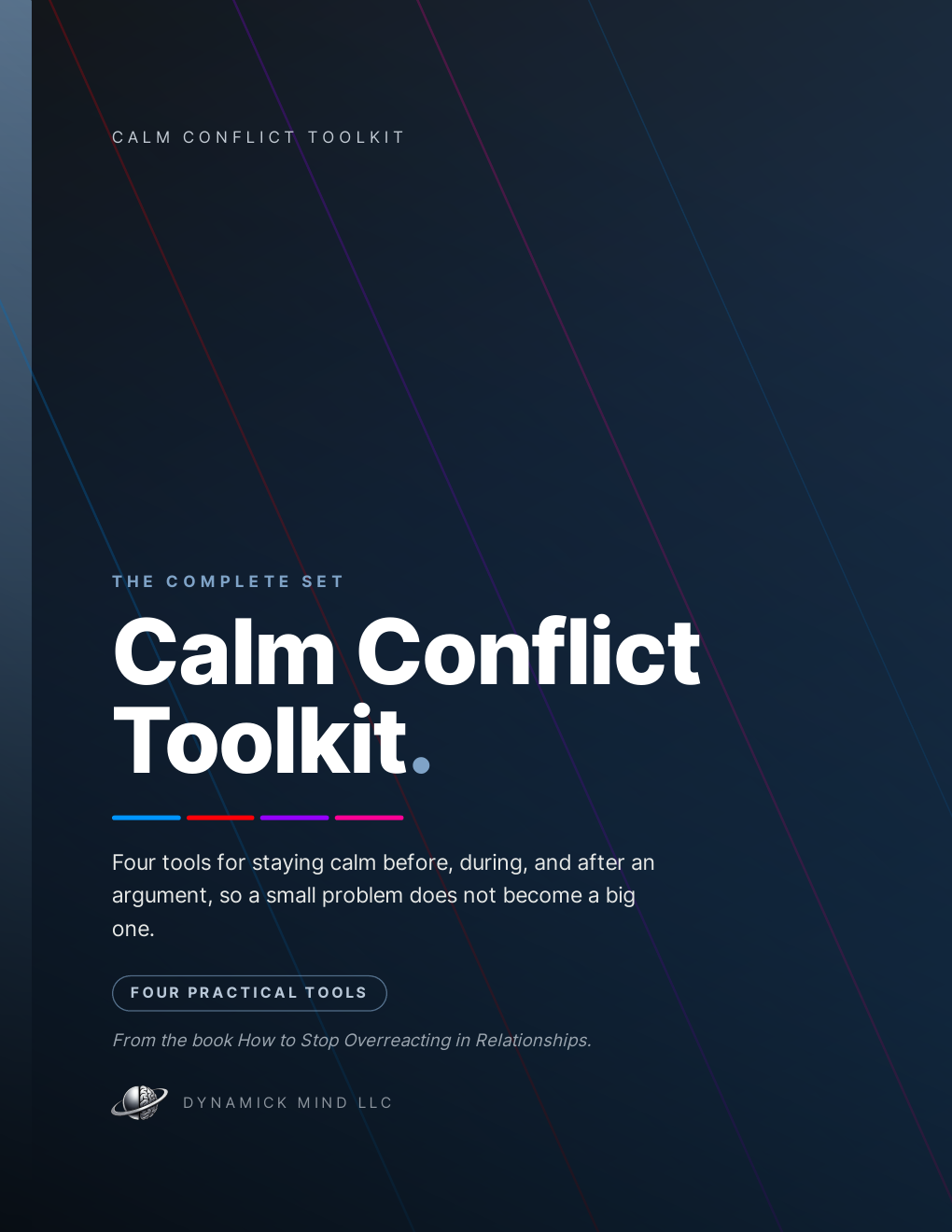
Calm Conflict Toolkit
Understanding conflict after it ends is easier than working with it while your body is activated. The Calm Conflict Toolkit gives you four concise tools for the moments when attention narrows and old patterns begin directing your response. Use them to reduce escalation, identify the trigger, check your interpretation, and return with language that supports repair.
- 01The Complete Framework
The full method in short form. Use it to recover the central distinctions quickly.
- 02Conflict De-Escalation Cheat Sheet
A direct sequence for the first minutes of activation.
- 03Trigger Mapping Worksheet
Map three specific incidents and find your earliest recurring signal.
- 04Repair Script Guide
Return after conflict with language for responsibility and reconnection.
In the moment
The pause sequence
Do these three things before you say anything, in order.
- 01Breathe out slowly.
Make the exhale longer than the inhale. Repeat once.
- 02Drop your shoulders.
Unclench your jaw and feel both feet on the floor.
- 03Check the source.
Am I responding to what happened, or to how triggered I feel?
Quick reference
Two questions create the first useful separation.
Describe only what you could see or hear. Do not add meaning yet.
Name the interpretation, assumption, evaluation, or story.
The space between those questions is where more choice can develop.
After conflict
Repair the behavior without attacking your identity.
Repair does not require complete agreement. It requires returning, taking responsibility for your behavior, and allowing reconnection.
“I overreacted and I am sorry. You did not deserve that.”
“I shut down instead of telling you what was going on. That was not fair to you.”
Keep the apology on behavior. A global character attack turns the conversation toward reassurance and away from repair.